Would You Ship It?

Flagsmith experiment, Track 01

A dashboard says Winning. Would you ship it?

A five-card game that shows you A/B test results and asks one question: ship or hold. Flagsmith decides which of three displays you see, and we measure which display leads to fewer wrong ship calls.

For product managers and engineers who act on a "Winning" banner, and for teams deciding how their own experiment results should be shown.

./start.sh

Needs Docker, Python 3.9+ and curl. In our fresh-copy runs (27 to 29 Nov, images already pulled) it was up in 45 seconds to 1.5 minutes. Allow a few minutes on a first run, plus the image download.

SimulatedRuns locally only. 0 real players. Every stored result comes from scripted visitors and is labelled so. The question the game asks has not been answered yet.

Card c062, from the game

Simulated test

Sample data on first screen

Metric: first query run

Chance to win
95.3%

Real numbers from src/data/cards.json. The real game serves 64 such cards, five per player.

The problem

One word is easy to act on, and hard to doubt.

Example persona, not a real user

A growth product manager has a new first-screen change in test. Mid-week, the experiment dashboard turns green and says Winning. The roadmap meeting is in an hour. Ship it, or hold?

Nothing on the banner says how many people have been counted, how wide the uncertainty is, or whether the test has run long enough to trust the early look.

  1. Early look, 500 per arm
    Winning, 95.3%

    Lift +106.7%. Interval -18.3% to +231.6%. 15 of 500 converted against 31 of 500.

  2. Nothing was different
    True lift: 0%

    Both groups saw the same thing. This is an A/A test, so any winner is noise.

  3. End of run, 2000 per arm
    Inconclusive, 88.4%

    Lift +20.0%. Interval -12.7% to +52.7%. The early "Winning" faded.
Card c062 from the bundled simulated set. Across 3,000 simulated no-effect runs with a look every 50 visitors per arm, a false "Winning" appeared at some look in 13.2% of them (our re-implementation of the documented formula, not Flagsmith's code; see Results for what that does and does not mean).

The game

Five cards. Ship or hold. Then the truth.

For each simulated result you press Ship or Hold and see what was really true. Flagsmith gives each player one of three displays, and the game records whether the call was right. Below are screenshots of the running app.

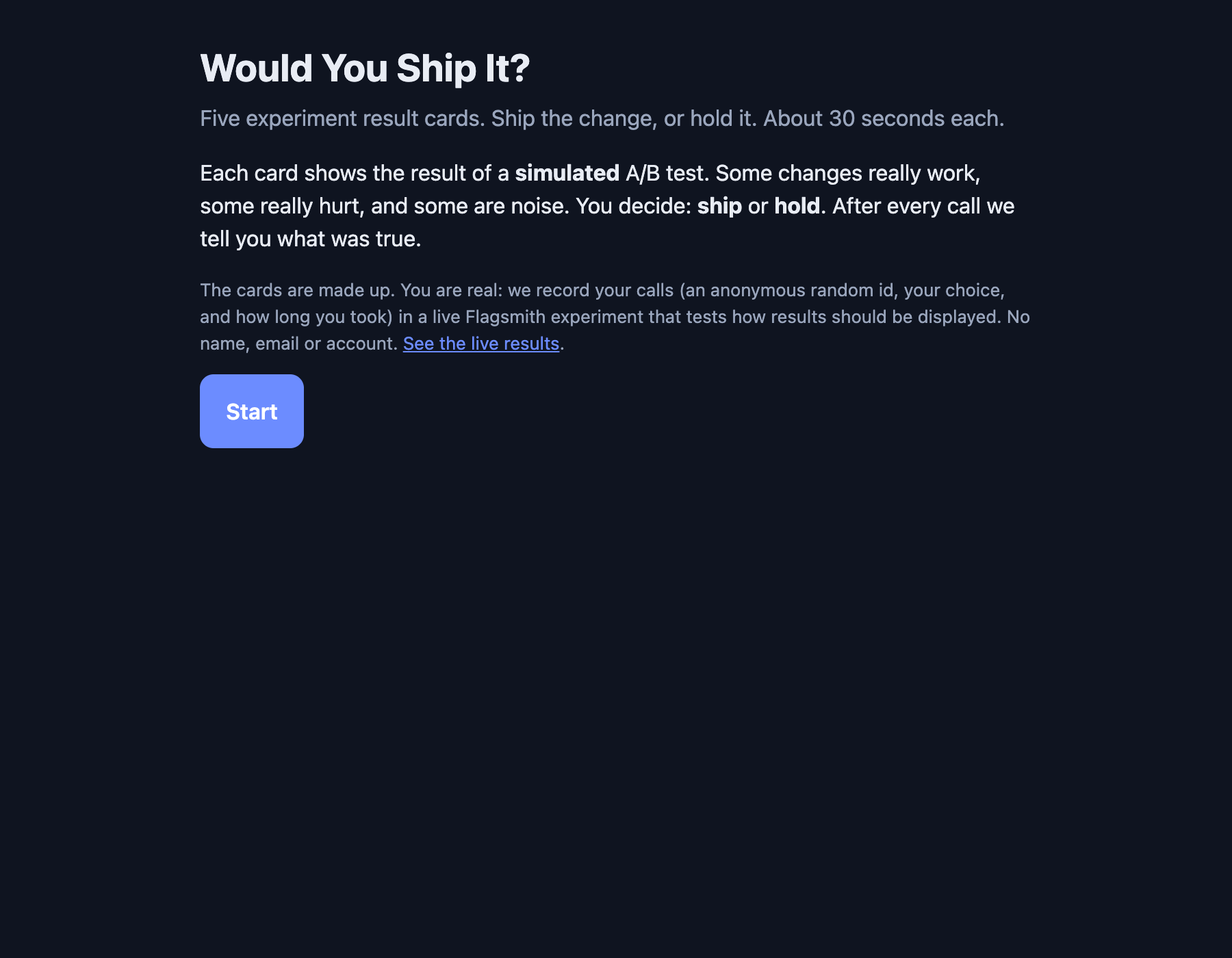
The intro screen: Would You Ship It, five experiment result cards, ship the change or hold it, with a Start button.
IntroPlain-language rules, and a note on what is recorded: an anonymous random id, the choice and the time taken.
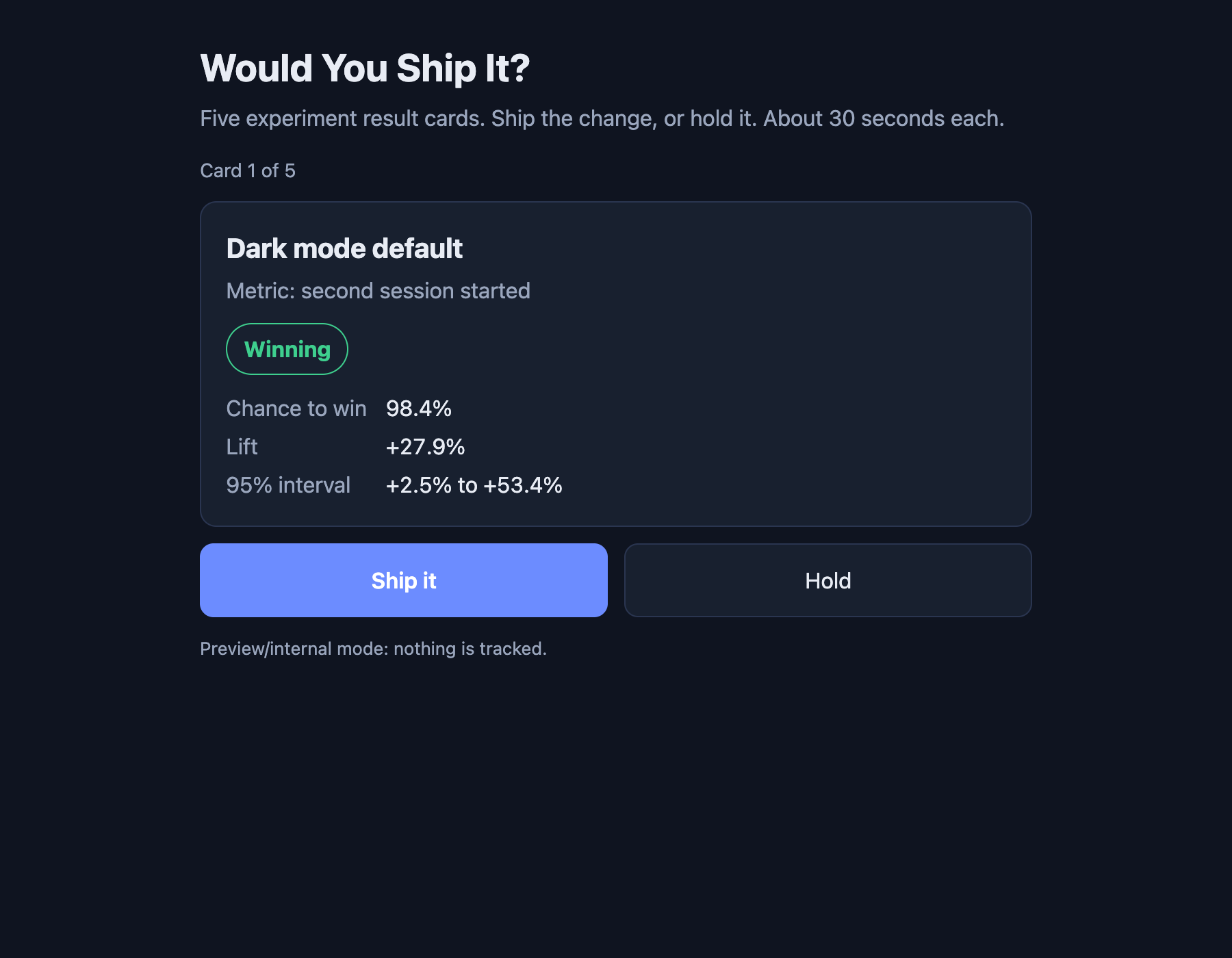
A result card with a Winning banner, chance to win, lift and 95 percent interval, with Ship it and Hold buttons.
Banner + intervalArm with_interval: the banner plus the lift and its 95% interval.
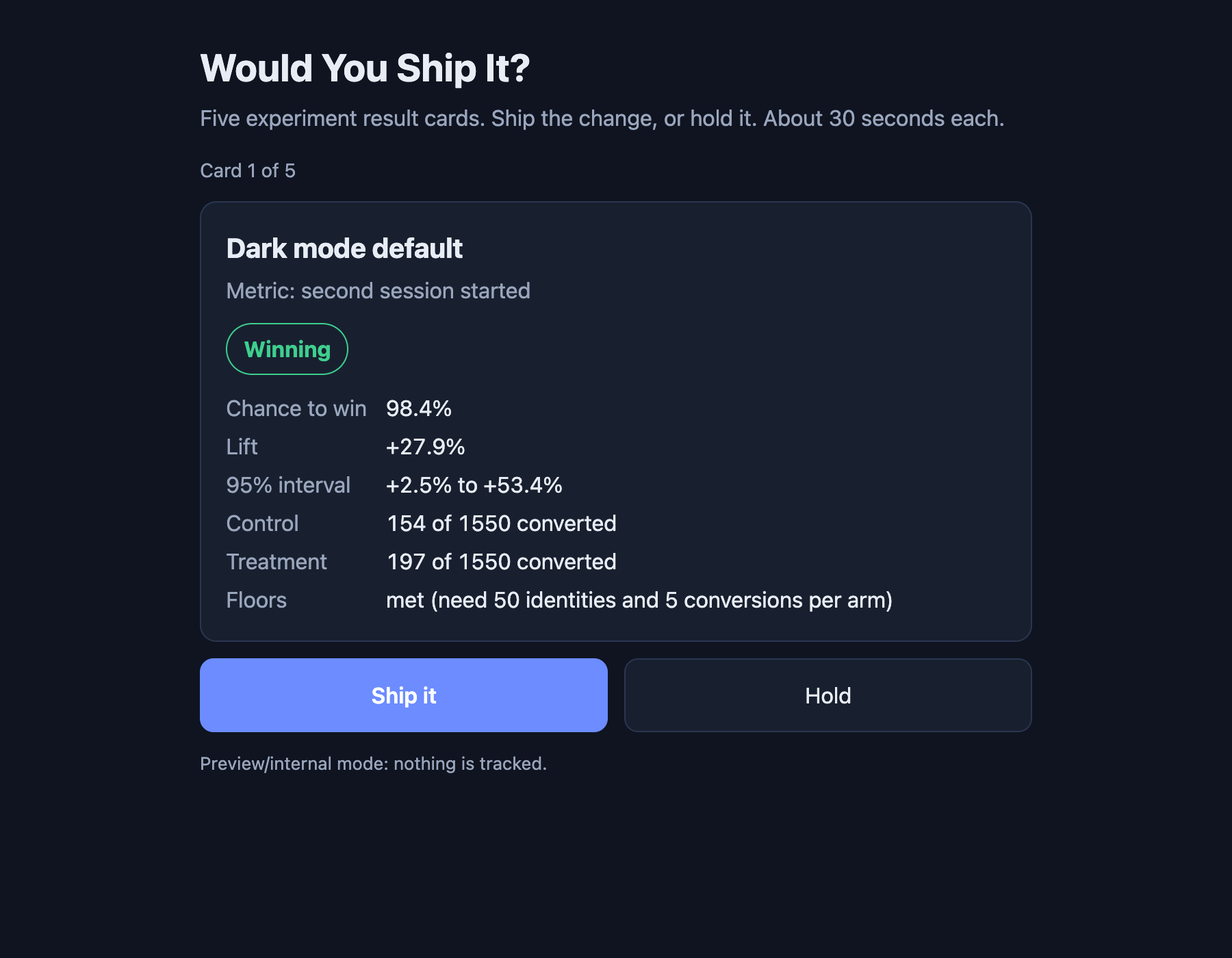
A result card for Dark mode default showing Winning, 98.4 percent chance to win, lift +27.9 percent, interval +2.5 to +53.4 percent, 154 of 1550 against 197 of 1550 converted, and floors met.
Interval, counts, floorsArm with_interval_and_floors: adds raw counts and whether the minimum-sample floors are met.
Arm (flag result_view)What the player sees on each card
banner_only (control)The banner (Winning, Losing, Inconclusive or Collecting data) and chance to win.
with_intervalThe banner, plus the lift and its 95% interval.
with_interval_and_floorsThe banner, the interval, the raw counts, and whether Flagsmith's minimum-sample floors are met (50 identities per arm, plus 5 conversions per arm on occurrence metrics).

The 64 cards are simulated, with known ground truth.

They come from a seeded generator and are bundled with the app. Four kinds, 16 each, so every call can be scored right or wrong.

  • True winners. Shipping is right.
  • True losers. Hold is right.
  • A/A noise. Nothing differs; any winner is chance.
  • Peeking cards. They look like winners at an early look, and are not.
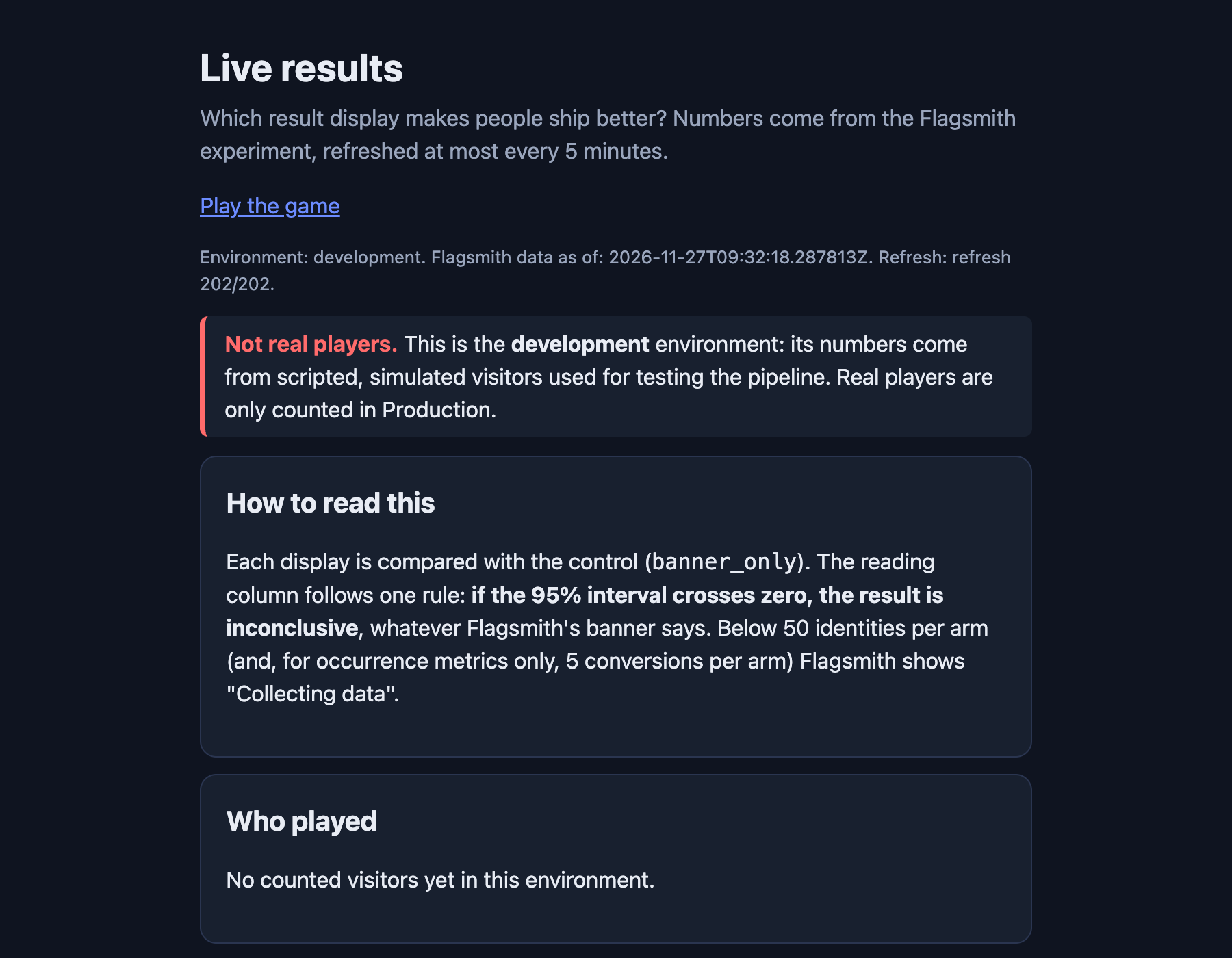
The results page for the Development environment, with a red notice that these are not real players but scripted simulated visitors, and a How to read this panel.
A results page that labels its own dataThe Development environment is simulated traffic, and the page says so. Its reading rule: if the 95% interval crosses zero, the result is inconclusive, whatever the banner says.

How it works

Flagsmith picks the display, records the call, and reports the result.

The game has no other source for which display you see. Each decision becomes an event, and the results page reads Flagsmith's experiment results back.

Data flow of Would You Ship It The browser talks to src/server.py and src/game.py. game.py reads the result_view flag from Flagsmith and sends events. Events flow to a warehouse and become experiment results. src/results.py reads them back over REST and adds a reading rule and a sample-ratio check for the results page. src/rollout.py decides and can complete the experiment in Flagsmith. Browserthe 5 cards server.py + game.pyassign arm, score,send events Flagsmith flag result_view (3 variations) exposures + 4 metric events warehouse -> experiment results get_experiment_flag track_event results.py, /results our reading rule:interval crosses 0 = inconclusive rollout.py decide: variant,control or wait REST read REST: complete experiment REST: refresh + read results page

Kill switch: turning the result_view flag off in the environment is picked up within about 5 seconds, and everyone sees the control display, untracked. If Flagsmith is unreachable the game falls back the same way and /api/health says so.

Flagsmith features the code actually uses

Flagsmith featureHow the code uses itWhere
Multivariate flagresult_viewControl banner_only; variations with_interval, with_interval_and_floors. Decides which display a player sees.src/setup_experiment.py, src/game.py
Experiment flag readget_experiment_flag(...)Returns the variation and records the exposure. Assignment is sticky: a visitor's arm is drawn once.src/game.py
Eventstrack_event(...)Sends first_call_correct, correct_calls, shipped_false_winner and seconds_to_decide after every decision.src/game.py
Environment flagsget_environment_flags()Reads the flag at environment level, so switching it off acts as a kill switch.src/game.py
Experiments and metrics, RESTSetup creates the organisation, project, Production and Development environments, a warehouse connection each, the flag, four metrics and one experiment per environment.src/setup_experiment.py, tools/fs.py
Results and exposures, RESTRefreshes and reads results for /results. The token stays on the server and the 5-minute cooldown is respected.src/results.py
Complete experiment, RESTrollout.py --apply completes the experiment with a rollout decision.src/rollout.py

Four metrics

first_call_correct (primary, occurrence, up); shipped_false_winner (guardrail, occurrence, down); correct_calls (count, up); seconds_to_decide (mean, down).

Production and Development

Production is where real players would go. Simulated traffic goes to Development, so it never mixes with real counts. ?internal=1 and ?preview= let you demo without adding exposures or events.

Results so far

No human data yet. Here is what the simulated runs show.

Everything below comes from scripted visitors or offline simulations. Nothing here says how people react to the three displays.

0

real players. The acceptance target was 300 real plays and it is not met. The only non-scripted plays are the builder's own test plays on throwaway projects.

If you act on the first crossing, how often is it wrong? Simulated

3,000 no-effect runs, 10% base rate, up to 2,000 identities per arm, a look every 50 per arm. Share of runs, percent.

Decisive at some look
45.8%
False Losing at some look
33.2%
False Winning at some look
13.2%
Decisive at the final look
10.4%

Source: tools/spikes/peek.py. 0.6% of runs were both Winning and Losing. This is our re-implementation of the documented formula, not Flagsmith's code. It measures how often the banner's cut-offs (95% and 5%) are crossed at some look when nothing differs, which is what happens to a reader who acts on the first crossing. Flagsmith's documentation says chance to win is safe to check at any time and does not claim these figures are a false-positive rate in its sense, and we do not dispute that. Looks are discrete, so a reader who checks more often would cross more often.

RunSetupOutcomeSource
A/A smoke run Simulated300 scripted visitors x 5 rounds = 1,500 plays; arms of 99 / 88 / 113Primary metric: no "Winning". Secondary seconds_to_decide: "Winning" twice (97.4%, 96.0%), intervals just crossing zero. Across 8 comparisons the banner alone gave 2 false wins and 1 false loss; the interval rule gave 0. Our own AC4 is not met as written.src/data/aa_results.json
Positive control Simulated1,200 scripted visitors x 5 rounds, planted effectwith_interval_and_floors +15.1% (interval +4.2% to +26.0%), clear. with_interval +5.5% (-5.1% to +16.1%), inconclusive. Shows the pipeline can see an effect we planted; it is not evidence about humans.src/data/poscontrol_results.json
A/A Monte Carlo Simulated3,000 simulated experiments per row, 300 to 1,200 visitorsBanner decisive in about 9 to 10.5% of comparisons; interval excludes zero in about 5%. With a planted effect the interval sees it in 11% (300), 24% (600), 44% (1,200).tools/spikes/aa_mc.py

So 300 real players is underpowered for anything but a large effect. Expect "inconclusive" and read it that way. The 9 to 10.5% versus 5% gap comes from the thresholds compared, and is not evidence that one display helps people more.

What it does not do

Limits, stated before you ask.

  • No real traffic, no finished live experiment.The Production experiment runs with 0 real players. The game's real question has no human data.
  • It can read as a study, not a product.You play a training game; what we report on is an experiment about that game.
  • A same-track entry asks almost the same question.Aafi04/verdict also tests whether a different display changes ship decisions, and uses the same flag name. We did not copy it.
  • Our own AC4 is not met.The secondary metric showed a false "Winning" banner twice in the A/A run (97.4%, 96.0%).
  • Static content, stored snapshots.Cards are a fixed bundle. Re-running the simulator gives new numbers of the same kind, not the same numbers.
  • Anonymous identity.No accounts. Clearing browser storage gives a new identity and a new assignment.
  • One known bug, not fixed.A fast double click on "Next card" can send two requests, so the scored card can differ from the one on screen.
  • Not checked yet.No public repository yet, so the CI workflow has never run. Fresh-copy runs checked the game over its HTTP API, only on macOS with images already pulled.
  • Our statistics are our own implementation.It reproduced one live Flagsmith result to 1e-8, which is not proof it matches in every case.
  • The guardrail sits near its ceiling.77% to 97% of players shipped at least one false winner in five cards, so an increase has almost no room to show. Treat it as descriptive.
  • Pausing the experiment does not change what Flagsmith serves.Use the flag kill switch instead. Flagsmith's pause behaviour comes from a 200-identity test we did not re-run.
  • Multiple comparisons are not corrected in the display.Treat a single secondary-metric "Winning" as a lead, not a finding. The rollout rule does apply a Bonferroni-corrected interval and refuses to decide below 100 identities per arm.

Run it and test it

One command starts everything.

Requirements: Docker, Python 3.9+ and curl. Tested with Flagsmith image version 2.295.2 and the flagsmith Python SDK 5.5.0. start.sh creates .env with random secrets, starts Flagsmith, creates the experiments and serves the game.

Start

# game on :8111, Flagsmith on :8101
./start.sh

# second terminal: end-to-end check
.venv/bin/python tools/smoke.py

# open
http://localhost:8111          # the game
http://localhost:8111/results  # results

If a port is busy: FS_PORT=8201 PORT=8211 ./start.sh

Simulate, decide, test

# scripted A/A run, Development only
.venv/bin/python src/simulate.py --visitors 300 --mode aa --fresh

# dry-run the rollout decision
python src/rollout.py --env production

# offline tests
.venv/bin/pip install -r requirements-dev.txt
.venv/bin/python -m pytest -q tests

As of 29 Nov 2026: 33 passed, 4 skipped without Flagsmith. The 4 live tests skip when no Flagsmith answers. With Flagsmith running, the last full run was 34 passed, 0 skipped.